

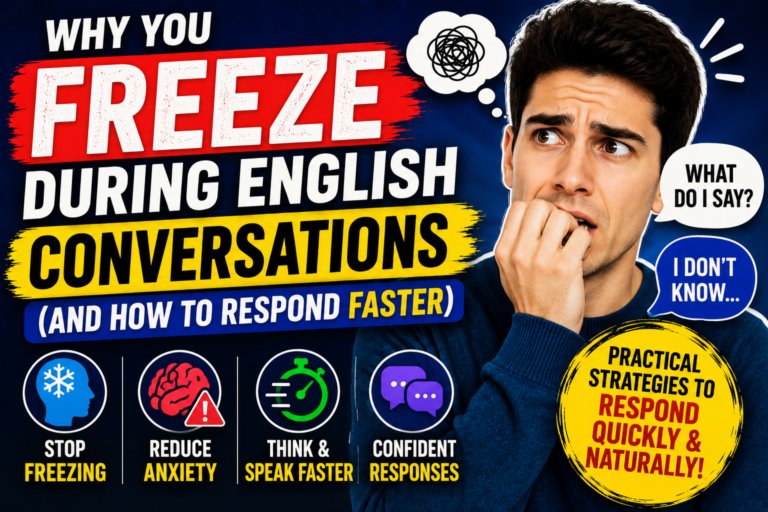
Freeze during English conversations long enough… and even simple conversations start to feel stressful.
Many ESL learners experience this.
You understand English while studying alone.
You know vocabulary.
You know grammar.
But the moment someone speaks to you directly in English:
- Your brain goes blank
- You panic
- You forget simple words
- Your response becomes slow
If this happens to you, the problem is not intelligence.
And it does not mean your English is bad.
In this guide, you’ll learn:
- Why learners freeze during English conversations
- What causes mental blank moments
- How to respond faster naturally
- How to build calm speaking confidence
Why Your Brain Freezes During Conversations
Real conversations create pressure.
Unlike reading or listening, conversations require your brain to do several things at once:
- understand the other person
- think of a response
- choose vocabulary
- organize grammar
- pronounce words clearly
- react quickly
That mental pressure can temporarily overload your brain.
Especially if you are nervous.
Related: How to Start Speaking English Confidently (Even If You Feel Nervous)
The Problem Is Usually NOT Vocabulary
This surprises many learners.
Most people who freeze during English conversations already know enough English to communicate.
The real problem is:
- pressure
- fear
- overthinking
- slow processing
Your brain becomes too focused on:
“What if I say something wrong?”
And that anxiety blocks the natural flow of English.
Why Nervousness Makes English Feel Harder
Stress affects language processing.
When you become anxious:
- Your brain processes information more slowly
- Memory becomes less accessible
- Simple words suddenly disappear
That is why some learners:
- speak well alone
- but struggle during real conversations
Confidence changes performance dramatically.
Related: How to Stop Being Shy When Speaking English
Watch out for this powerful article soon.
Stop Trying to Build Perfect Responses
This is one of the biggest reasons learners hesitate.
Many people silently build full “perfect” sentences before speaking.
That creates a delay.
Real conversations move too quickly for perfection.
Instead of:
“I need the perfect grammar.”
Focus on:
“Can the other person understand me clearly?”
Simple English spoken confidently is more effective than perfect English spoken nervously.
Related: How to Stop Translating in Your Head When Speaking English
https://fluent-eng.com/how-to-stop-translating-in-your-head-when-speaking/
Learn to Use “Bridge Phrases”
Native speakers do this constantly.
Bridge phrases buy your brain time while sounding natural.
Examples:
- “Let me think…”
- “That’s a good question.”
- “I’m not really sure, but…”
- “How can I explain this…”
These phrases reduce pressure because you do not need instant, perfect answers.
They help conversations flow naturally.
Train Faster Responses with Timed Speaking
This exercise is extremely effective.
Step 1
Choose a simple topic:
- food
- travel
- movies
- work
- hobbies
Step 2
Set a timer for 30 seconds.
Step 3
Speak continuously without stopping completely.
Do not worry about mistakes.
The goal is:
- speed
- flow
- confidence
This teaches your brain to react faster under pressure.
Practice Exercise: How to Answer Questions Quickly in English Without Overthinking
It will be published soon, watch out!
Why Overthinking Slows You Down
Many learners mentally check:
- grammar
- pronunciation
- vocabulary
- sentence structure
before speaking.
That creates hesitation.
Fast speakers are not necessarily smarter.
Often, they simply allow themselves to speak more freely.
Confidence grows when you stop monitoring every word excessively.
How to Recover When Your Mind Goes Blank
Even advanced speakers sometimes lose words.
The difference is:
They recover quickly.
Here is what to do instead of freezing completely:
Simplify
Use easier English.
Instead of:
“I’m attempting to communicate…”
Say:
“I’m trying to say…”
Rephrase
Explain the idea differently.
Even if one word disappears, communication can continue.
Keep talking
Do not panic during pauses.
Short pauses are normal in conversations.
Practice Real Conversation Reactions
Many learners practice vocabulary lists…
but not real responses.
Practice reacting naturally to questions like:
- “What did you do today?”
- “What kind of music do you like?”
- “What are your plans this weekend?”
Answer immediately without translating too much.
This improves real speaking speed.
Practice Questions: English Conversation Questions to Practice Speaking Confidence
(Coming out soon: watch out)
Why Listening Improves Speaking Speed
Your brain learns patterns through repetition.
The more natural English you hear:
- The more predictable conversations become
- The easier responses feel
- The less pressure your brain experiences
Listen regularly to:
- podcasts
- interviews
- casual conversations
- YouTube discussions
Pay attention to:
- common responses
- conversational rhythm
- natural pauses
Signs Your Speaking Confidence Is Improving
You are progressing when:
- You recover faster after mistakes
- Conversations feel less stressful
- You hesitate less often
- You answer more naturally
- Your brain feels calmer while speaking
These are major fluency improvements.
A Simple Daily Anti-Freezing Routine
3 minutes
Answer random questions quickly.
3 minutes
Practice bridge phrases naturally.
2 minutes
Speak about your day continuously.
2 minutes
Record yourself speaking without stopping.
This builds real conversation confidence gradually.
Practice Method: How to Practice Speaking English Alone (Without a Speaking Partner)
https://fluent-eng.com/how-to-practice-speaking-english-alone-without-speaking-partner/
Final Thoughts
If you freeze during English conversations, you are not failing.
Your brain is simply adjusting to the pressure of real-time communication.
That improves through:
- repetition
- faster reactions
- reduced overthinking
- regular speaking practice
Fluent conversation is not about perfection.
It is about staying calm enough to keep communicating.
And that confidence grows one conversation at a time.
Continue learning: How to Start Speaking English Confidently (Even If You Feel Nervous)