

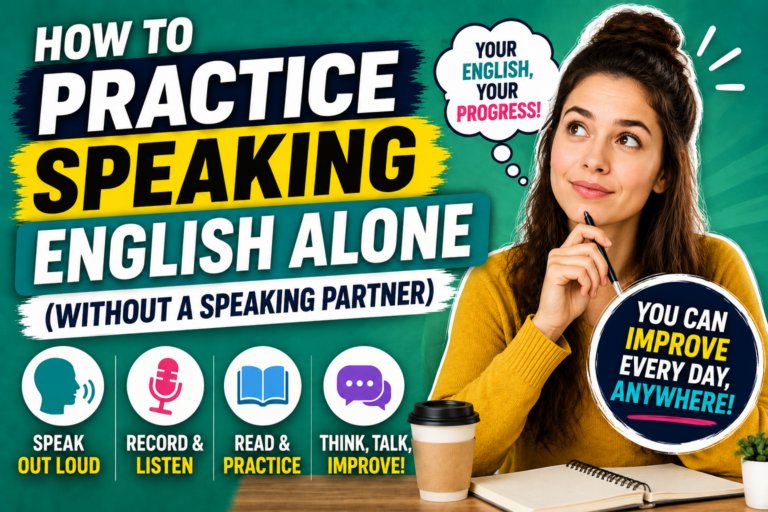
Practice speaking English alone long enough… and your confidence, fluency, and speaking speed can improve dramatically.
Many ESL learners believe they cannot improve because:
- They have nobody to practice with
- They feel isolated
- They do not live in an English-speaking country
- They cannot afford tutors or classes
But here is the truth:
You can make serious progress even without a speaking partner.
In fact, many fluent English speakers improved largely through solo practice before speaking comfortably with others.
In this guide, you’ll learn:
- How to practice speaking English alone effectively
- daily solo speaking exercises
- How to sound more natural
- How to build confidence without depending on other people
Why Solo English Practice Actually Works
Speaking is a skill.
And skills improve through repetition.
Many learners wait for:
- perfect conditions
- native speakers
- conversation partners
before practicing seriously.
That delay slows progress.
Solo English speaking practice allows you to:
- practice daily
- make mistakes freely
- build confidence privately
- train your brain consistently
And consistency matters more than occasional conversations.
Related: How to Start Speaking English Confidently (Even If You Feel Nervous)
Stop Waiting Until You Feel “Ready”
This is one of the biggest mistakes learners make.
Many people think:
“I’ll start speaking when my English improves.”
But speaking is what CAUSES improvement.
Fluency grows through use.
Not silence.
Even short daily speaking sessions help your brain:
- think faster
- organize ideas faster
- react more naturally in English
Related: How to Stop Being Shy When Speaking English
You will find this article useful (Watch out for it)
Talk About Your Day Out Loud
This is one of the easiest and most effective solo speaking exercises.
Describe:
- What you are doing
- What you’re thinking
- What happened today
- What you plan to do later
Examples:
- “I’m making coffee.”
- “Today was stressful.”
- “I need to finish my work.”
- “The weather feels nice today.”
This builds automatic speaking habits naturally.
Use the “Question and Answer” Method
This method trains real conversation thinking.
Ask yourself questions in English.
Then answer immediately.
Examples:
- “What did I eat today?”
- “What is my favourite movie?”
- “What do I want to learn next?”
Now answer naturally:
- “I ate pasta today.”
- “My favourite movie is…”
- “I want to improve my pronunciation.”
This teaches your brain how to react quickly in conversations.
Practice Questions: English Conversation Questions to Practice Speaking Confidence
(Watch out! It will be posted soon)
Record Yourself Speaking
Most learners avoid this because it feels uncomfortable.
But it is one of the fastest ways to improve spoken English on your own.
Why?
Because recordings reveal:
- pronunciation problems
- hesitation patterns
- unnatural rhythm
- Repeated grammar mistakes
You begin hearing your English more objectively.
Read Short Texts Out Loud
Silent reading does not train speaking muscles.
Reading aloud helps improve:
- pronunciation
- rhythm
- sentence flow
- speaking confidence
Start with:
- short articles
- dialogue
- social media captions
- simple stories
Focus on:
- clarity
- smooth pacing
- natural pauses
Not speed.
Use Shadowing for Natural Speech
Shadowing is a powerful technique used by advanced language learners.
How it works:
- Listen to a native speaker
- Repeat immediately after them
- Copy rhythm and tone closely
Do not focus only on vocabulary.
Focus on:
- flow
- pronunciation
- stress
- connected speech
This helps your English sound more natural over time.
Related: How to Stop Translating in Your Head When Speaking English
Practice Speaking Without Stopping Completely
Many learners stop speaking every time they forget a word.
That creates fear and hesitation.
Instead:
Keep talking.
Even if you need simpler English.
For example:
Instead of freezing because you forgot:
“microwave”
Say:
“the machine that heats food”
Communication matters more than perfect vocabulary.
Related: Why You Freeze During English Conversations (And How to Respond Faster)
Create “Mini Conversations” Alone
This exercise works extremely well.
Pretend somebody asked you:
- “How was your day?”
- “What do you do for work?”
- “What are your hobbies?”
Now answer naturally out loud.
This simulates real conversation pressure in a safe environment.
Why Daily Practice Matters More Than Long Practice
You do not need hours.
You need consistency.
Ten minutes daily is more effective than:
- two hours once a week
- random practice occasionally
Daily repetition helps your brain:
- process English faster
- reduce hesitation
- build automatic speaking habits
Common Mistakes Learners Make
- Practicing silently only
Speaking improves through actual speaking.
- Focusing too much on grammar
Overthinking grammar slows fluency.
- Avoiding recordings
Recordings reveal important weaknesses.
- Waiting for confidence first
Confidence develops through practice, not before practice.
A Simple 10-Minute Solo Speaking Routine
2 minutes
Describe your surroundings.
3 minutes
Answer random questions out loud.
2 minutes
Read a short text aloud.
2 minutes
Shadow a short English clip.
1 minute
Record yourself speaking freely.
This routine builds speaking confidence surprisingly fast.
Practice Exercise: How to Answer Questions Quickly in English Without Overthinking
(This article offers solutions to major English problems: Out soon!)
Signs Your English Is Improving
You are progressing when:
- Speaking feels less stressful
- Responses come faster
- You hesitate less
- Pronunciation becomes clearer
- English feels more automatic
These are real fluency improvements.
Final Thoughts
Learning to practice speaking English on your own is one of the most valuable skills an ESL learner can develop.
You do not need:
- perfect grammar
- expensive tutors
- native-speaking friends
You need:
- repetition
- consistency
- active speaking practice
Small daily speaking habits create powerful long-term improvement.
And the more often you speak… the more natural English becomes.
Continue learning: How to Start Speaking English Confidently (Even If You Feel Nervous)
https://fluent-eng.com/how-to-start-speaking-english-confidently/