

You know more English than you think.
The real question is…
Can you use it naturally in everyday situations?
Many English learners understand grammar and vocabulary but hesitate when they need to respond quickly. That’s because real conversations move fast. People don’t stop to explain grammar rules or wait while you translate each sentence.
This everyday English challenge is designed to help you practise common situations you might face at work, while travelling, shopping, meeting new people, or chatting with friends.
Don’t worry if you don’t get every answer right.
The goal isn’t a perfect score. The goal is to learn something new.
How the Challenge Works
For each situation:
- Read the scenario.
- Think about what you would say.
- Compare your answer with the suggested response.
- Notice the natural expressions used.
Keep track of your score at the end.
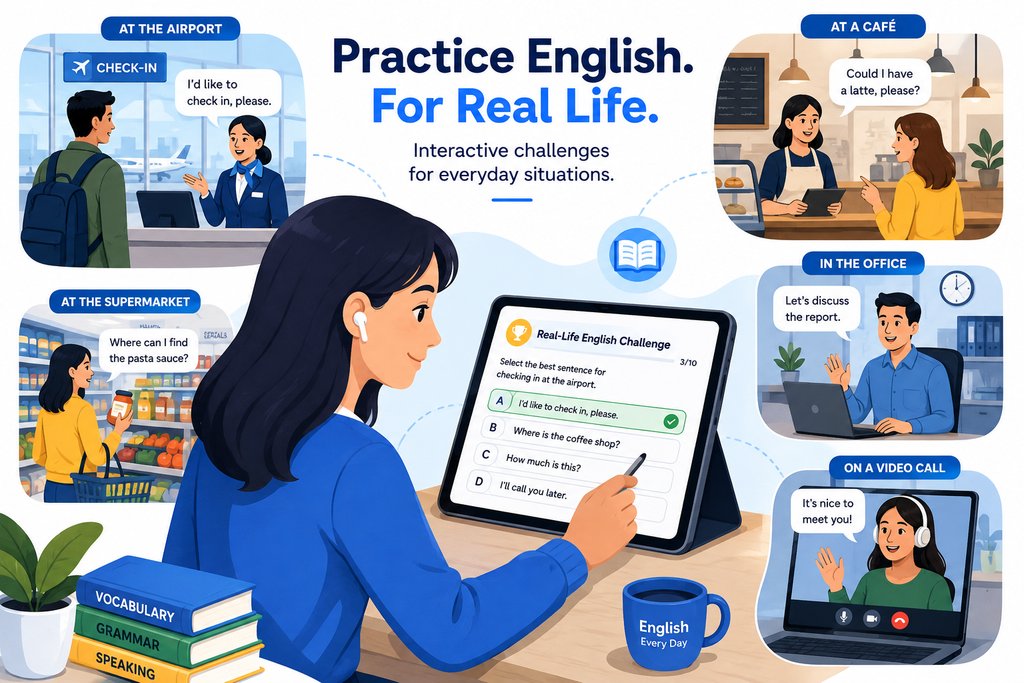
English learner completing an interactive English challenge based on real-life situations.
The Challenge
1. Meeting Someone New
Situation
Someone says,
“Hi! I’m Emma.”
What would you say?
✅ Suggested Answer
“Hi, Emma. Nice to meet you!”
2. Ordering Coffee
The barista asks,
“What can I get for you?”
✅
“I’d like a cappuccino, please.”
3. Asking Someone to Repeat
You didn’t hear what your colleague said.
Which sounds more natural?
A. Repeat your statement.
B. Could you say that again, please?
✅ Correct Answer
B
4. Being Late
Your meeting started five minutes ago.
What should you say?
✅
“Sorry I’m late.”
Simple and polite.
5. Asking for Directions
You can’t find the train station.
✅
“Excuse me, could you tell me how to get to the train station?”
6. Receiving a Compliment
Someone says,
“Your English is improving.”
A natural response is:
✅
“Thank you! I’ve been practising a lot.”
7. Leaving a Conversation
You’re ready to go home.
Try saying:
- I’d better get going.
- It was nice talking to you.
- See you later!
8. Answering the Phone
Instead of saying,
“Who are you?”
Try:
“May I ask who’s calling?”
It sounds much more polite.
9. Shopping
The cashier asks,
“Would you like a receipt?”
A natural answer is:
“Yes, please.”
or
“No, thanks.”
10. Asking for Help
You’re in a supermarket and can’t find something.
Say:
“Excuse me, could you help me find the milk?”
Quick Checkpoint
How many have you answered correctly so far?
- 8 to 10: Excellent!
- 5 to 7: You’re making good progress.
- 0 to 4: Keep practising. You’re learning with every challenge.
Let’s continue.
11. Making Small Talk
Someone asks,
“How’s your day going?”
Possible answers:
- Pretty good, thanks.
- It’s been busy.
- Can’t complain!
12. At the Airport
You didn’t understand the announcement.
Say:
“Could you repeat that, please?”
13. In an Online Meeting
Your internet cuts out.
Say:
“Sorry, I think my connection dropped.”
14. Asking Someone to Wait
You’re finishing another task.
Say:
“Just a moment, please.”
or
“I’ll be with you in a minute.”
15. Making a Suggestion
Instead of:
“We should perhaps visit the museum.”
Try:
“Why don’t we visit the museum?”
or
“How about visiting the museum?”
16. Accepting an Invitation
Your friend invites you to dinner.
Say:
“I’d love to. Thanks for inviting me!”
17. Politely Declining
You can’t attend.
Say:
“Thanks for inviting me, but I already have plans.”
18. Asking Someone’s Opinion
Try:
“What do you think?”
or
“What’s your opinion?”
19. Ending a Video Call
Natural options include:
- Talk to you soon.
- Have a great day.
- Bye for now.
20. Saying Goodbye After a Meeting
Instead of only saying,
“Goodbye.”
Try:
- Take care.
- Have a good weekend.
- Catch you later.
- See you tomorrow.
Congratulations!
You’ve completed the everyday English challenge.
Score Yourself
| Score | Level |
| 18–20 | Excellent communicator |
| 15–17 | Confident English user |
| 10–14 | Building confidence |
| Below 10 | Great start. Keep practising every day. |
Your score isn’t a final grade.
It’s simply a snapshot of where you are today.
Five Tips to Improve Faster
If you found some situations difficult, here are five ways to improve:
Listen Every Day
Watch YouTube videos, podcasts, or TV shows in English. Pay attention to how people naturally respond in conversations.
Practise Out Loud
Reading silently is helpful, but speaking aloud builds confidence and fluency.
Learn Useful Phrases
Instead of memorising single words, learn complete expressions you can use immediately.
Don’t Fear Mistakes
Every conversation is an opportunity to improve. Native speakers care more about understanding you than hearing perfect grammar.
Repeat Real-Life Situations
Role-play common conversations with a friend, teacher, or AI assistant. The more familiar these situations become, the more confident you’ll feel.
Mini Challenge
Think about your day.
Choose three situations from this article and say your answers aloud without reading them.
Then change the situation slightly.
For example:
Instead of ordering coffee, imagine you’re ordering lunch.
Instead of meeting Emma, imagine you’re meeting your new manager.
This simple exercise helps you use English more flexibly.
Final Thoughts
The best way to improve your English isn’t by memorising hundreds of grammar rules.
It’s by practising situations you’ll actually experience.
That’s why this everyday English challenge focuses on real conversations instead of textbook exercises.
Come back in a few weeks and take the challenge again.
You may be surprised by how much you’ve improved.
Frequently Asked Questions
How often should I take English challenges?
Once a week is a great starting point. Regular practice helps reinforce what you’ve learned.
Is this challenge suitable for beginners?
Yes. Most situations use simple English that learners from A2 to B2 levels can understand.
Should I memorise these answers?
It’s better to understand the patterns and practise creating your own responses than to memorise every sentence.
- Why You Understand English but Can’t Speak: 7 Proven Ways to Build Speaking Confidence
https://fluent-eng.com/why-you-understand-english-but-cant-speak/ - Stop Sounding Like a Textbook: 35 Everyday English Phrases Native Speakers Actually Use
https://fluent-eng.com/35-everyday-english-phrases-native-speakers-use/ - How to Use AI to Learn English Without Becoming Dependent on It
https://fluent-eng.com/how-to-use-ai-to-learn-english-speaking-and-writing/
Read Next
Are You Learning English the Wrong Way? 7 Study Habits That Slow Your Progress
Many learners study for years without seeing the results they want. In the next article, you’ll discover seven common habits that may be holding you back and how to replace them with smarter learning strategies.