

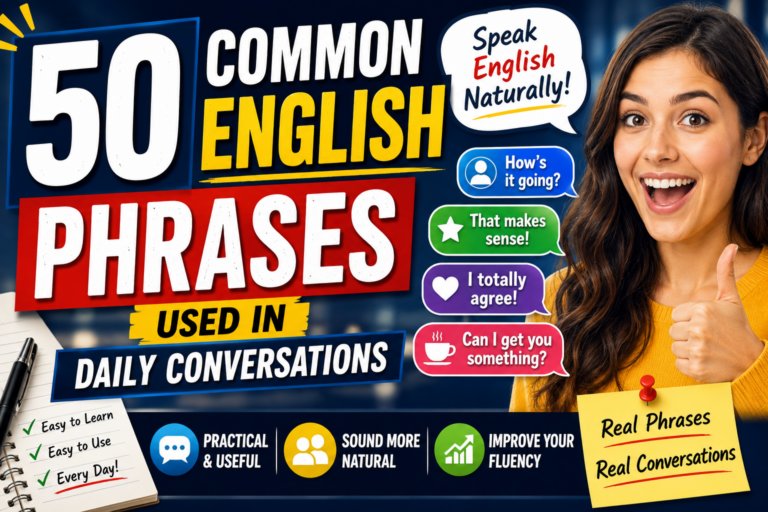
If you want to speak English fluently, learning individual words is not enough.
You need to learn phrases.
These are the expressions native speakers use every day in real conversations. Once you start using them, your English will sound more natural and less like a textbook.
In this guide, you’ll learn 50 common English phrases used in daily conversations, with clear examples so you know exactly how to use them.
👉If you want to speak English fluently, read:
How to Speak English Fluently (Step-by-Step Guide for Beginners)
https://fluent-eng.com/how-to-speak-english-fluently-a-step-by-step-guide/
Everyday Conversation Starters
These help you begin conversations naturally.
- How’s it going?
Example: Hey, how’s it going? - What’s up?
Example: Hi! What’s up? - How have you been?
Example: Long time no see. How have you been? - Nice to see you
Example: Nice to see you again. - It’s been a while
Example: It’s been a while since we talked.
Expressing Opinions
These are useful when sharing your thoughts.
- I think that…
Example: I think that this is a good idea. - I believe…
Example: I believe this will work. - In my opinion…
Example: In my opinion, this is better. - I feel like…
Example: I feel like we should wait. - To be honest…
Example: To be honest, I don’t like it.
👉If you want to learn how to think in English, read:
How to Think in English (Full Guide for Beginners)
https://fluent-eng.com/how-to-think-in-english-full-guide-for-beginners/
Agreeing and Disagreeing
- I agree
Example: I agree with you. - Exactly!
Example: Exactly! That’s what I meant. - That’s true
Example: That’s true. - I don’t think so
Example: I don’t think so. - I’m not sure about that
Example: I’m not sure about that idea.
Asking for Help or Clarification
- Can you help me?
Example: Can you help me with this? - Could you explain that?
Example: Could you explain that again? - What do you mean?
Example: What do you mean by that? - I don’t understand
Example: Sorry, I don’t understand.
👉To overcome common speaking mistakes, read:
10 Common English Speaking Mistakes (And How to Fix Them)
https://fluent-eng.com/10-common-english-speaking-mistakes-how-to-fix-them/
- Can you repeat that?
Example: Can you repeat that, please?
Daily Situations
- I’m running late
Example: Sorry, I’m running late. - I’ll be there soon
Example: I’ll be there soon. - Let’s go
Example: Let’s go now. - I’m on my way
Example: I’m on my way. - Give me a second
Example: Give me a second.
Making Suggestions
- We should…
Example: We should try that. - Why don’t we…
Example: Why don’t we go out? - Let’s…
Example: Let’s start now. - How about…
Example: How about this option? - What if we…
Example: What if we leave early?
Expressing Feelings
- I’m tired
Example: I’m tired today. - I’m excited
Example: I’m excited about this. - I’m worried
Example: I’m worried about that. - I’m happy
Example: I’m really happy. - I’m stressed
Example: I’m stressed right now.
Reacting in Conversations
- Really?
Example: Really? That’s interesting. - No way!
Example: No way! That’s amazing. - That’s great
Example: That’s great news. - That’s too bad
Example: That’s too bad. - Sounds good
Example: Sounds good to me.
Ending Conversations
- Talk to you later
Example: Okay, talk to you later. - See you soon
Example: See you soon. - Take care
Example: Take care. - Have a good day
Example: Have a good day. - Catch you later
Example: Catch you later.
Extra Useful Phrases
- It depends
Example: It depends on the situation. - That makes sense
Example: That makes sense. - I’m not sure
Example: I’m not sure. - Let me think
Example: Let me think about it. - I’ll try
Example: I’ll try my best.
How to Use These Phrases Effectively
Learning phrases is one thing. Using them naturally is another.
Start small:
- Pick 5–10 phrases
- Use them in daily conversations
👉Use this daily speaking routine practice:
Daily English Speaking Practice Routine
https://fluent-eng.com/daily-english-speaking-routine-simple-beginner-plan/
- Repeat them often
Over time, they become automatic.
How This Helps You Speak Fluently
When you use phrases:
- You speak faster
- You sound more natural
- You don’t need to think about grammar as much
👉 For a full system, read:
How to Speak English Fluently (Step-by-Step Guide for Beginners)
https://fluent-eng.com/how-to-speak-english-fluently-a-step-by-step-guide/
Practice Tip (Don’t Skip This)
Try this simple exercise:
- Choose 5 phrases
- Say them out loud
- Use them in sentences about your day
Example:
“To be honest, I’m tired today.”
“I think I need to rest.”
Final Thoughts
Fluent English is not about knowing everything.
It’s about using the right phrases at the right time.
Start practicing these daily conversation phrases… and you’ll notice your English becoming smoother and more natural.