

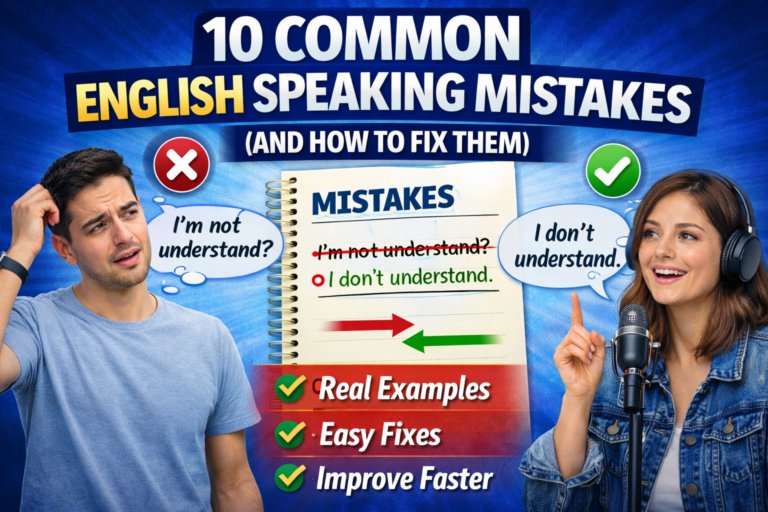
English speaking mistakes are among the biggest reasons learners struggle with fluency, even after months or years of practice.
If you’re learning English, you’ve probably asked yourself:
“Why do I still make mistakes when I speak?”
Here’s the truth.
Mistakes are normal. Every learner makes them.
But some English speaking mistakes happen again and again… and they quietly slow down your fluency.
In this guide, you’ll learn the most common English speaking mistakes and how to fix them with simple, clear examples.
1. Translating Before Speaking
❌ The mistake:
Thinking in your native language, then translating into English.
Why it’s a problem:
This is one of the most common English speaking mistakes because it slows you down and makes you hesitate.
✅ Fix:
Think in simple English.
Instead of:
Translating a full sentence
Say:
“I’m tired.”
“I need help.”
👉 Learn how to think in English here:
How to Think in English (Full Guide for Beginners)
https://fluent-eng.com/how-to-think-in-english-full-guide-for-beginners/
2. Trying to Use Difficult Words
❌ The mistake:
Using complex vocabulary to sound “advanced.”
Why it’s a problem:
It leads to more English speaking mistakes and breaks your flow.
✅ Fix:
Use simple, clear English.
Example:
❌ “I would like to express my dissatisfaction…”
✅ “I don’t like this.”
Simple English is fluent English.
3. Speaking Without Practice
❌ The mistake:
Only reading or studying grammar.
Why it’s a problem:
Many English speaking mistakes come from lack of real speaking practice.
✅ Fix:
Follow a daily routine.
👉 Start here:
Daily English Speaking Practice Routine
4. Being Afraid of Mistakes
❌ The mistake:
Not speaking because you’re afraid of getting it wrong.
Why it’s a problem:
Fear creates more English speaking mistakes over time because you avoid practice.
✅ Fix:
Focus on communication, not perfection.
Mistakes help you learn faster.
5. Using the Same Phrases Repeatedly
❌ The mistake:
Always saying things like:
“I think”
“Very good”
“Very big”
Why it’s a problem:
This is a subtle English speaking mistake that makes your speech sound limited.
✅ Fix:
Learn new phrases and alternatives.
Example:
Instead of “I think” → “I believe,” “I’d say”
Instead of “very good” → “great,” “excellent”
6. Speaking Too Fast
❌ The mistake:
Trying to speak quickly to sound fluent.
Why it’s a problem:
It increases English speaking mistakes and reduces clarity.
✅ Fix:
Speak slowly and clearly.
Fluency is about smoothness, not speed.
7. Not Listening to Natural English
❌ The mistake:
Not exposing yourself to real conversations.
Why it’s a problem:
You miss how natural English sounds, which leads to repeated English speaking mistakes.
✅ Fix:
Listen to:
Conversations
Videos
Podcasts
Then repeat what you hear.
8. Overthinking Grammar
❌ The mistake:
Trying to build perfect sentences before speaking.
Why it’s a problem:
This creates hesitation and more English speaking mistakes in real conversations.
✅ Fix:
Speak first. Improve later.
Communication is more important than perfection.
9. Not Thinking in English
❌ The mistake:
Always thinking in your native language.
Why it’s a problem:
It’s one of the biggest causes of English speaking mistakes because it creates delay and confusion.
✅ Fix:
Practice thinking in English daily.
Even simple thoughts help.
10. Inconsistent Practice
❌ The mistake:
Practicing once in a while.
Why it’s a problem:
Inconsistency leads to repeated English speaking mistakes and slow progress.
✅ Fix:
Practice every day, even for 10–15 minutes.
Consistency is the key to fluency.
How to Improve Faster (Simple Strategy)
If you want to reduce English speaking mistakes quickly:
Speak every day
Think in English
Use simple sentences
Learn useful phrases
You don’t need to do everything at once.
Start small… and stay consistent.
How This Connects to Fluency
Fixing these English speaking mistakes helps you:
Speak faster
Feel more confident
Sound more natural
👉 For the full fluency system, read:
How to Speak English Fluently (Step-by-Step Guide for Beginners)
https://fluent-eng.com/how-to-speak-english-fluently-a-step-by-step-guide/
Final Thoughts
Making English speaking mistakes is not a problem.
Repeating the same English speaking mistakes is.
Once you understand what to fix and how to fix it, your progress becomes much faster.
Stay consistent, keep practising, and your English will improve step by step.