

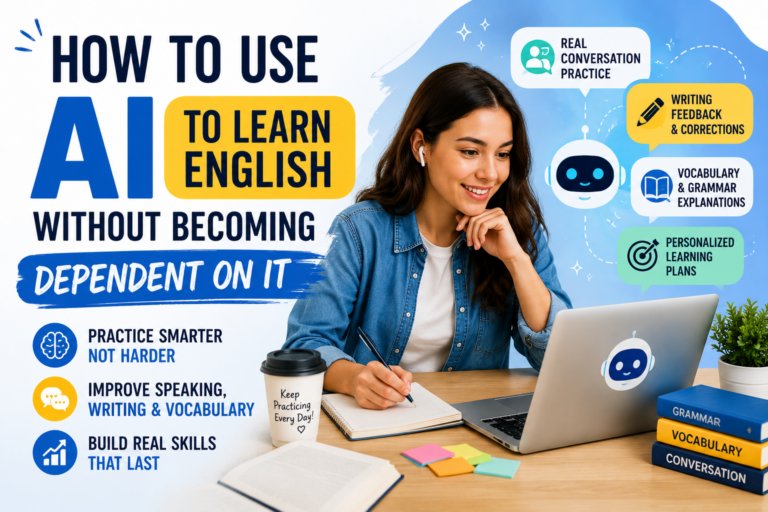
Artificial intelligence has changed the way people learn almost everything, including English.
Today, you can ask AI to explain grammar, create vocabulary quizzes, correct your writing, and even have full conversations in English.
That’s exciting.
But there’s one important question.
Can you use AI to learn English without becoming so dependent on it that your progress slows down?
The answer is yes.
Like any tool, AI can either help you grow or become a shortcut that keeps you from thinking for yourself. The difference lies in how you use it.
This guide will show you how to make AI your personal English coach as you continue to build real communication skills.
Why AI Is So Popular for English Learners
Traditional language learning often follows one path.
Read a lesson.
Complete a few exercises.
Move on to the next chapter.
AI is different.
It gives you instant feedback.
You can ask questions at any time, practise conversations, and receive explanations that match your level.
That’s why millions of learners now use AI to learn English every day.
What AI Can Do Well
AI is excellent at helping you:
- Explain grammar in simple English.
- Learn new vocabulary.
- Correct spelling mistakes.
- Rewrite awkward sentences.
- Generate conversation topics.
- Practise interview questions.
- Create personalised quizzes.
- Explain difficult idioms.
Think of AI as a patient tutor that’s available whenever you need help.
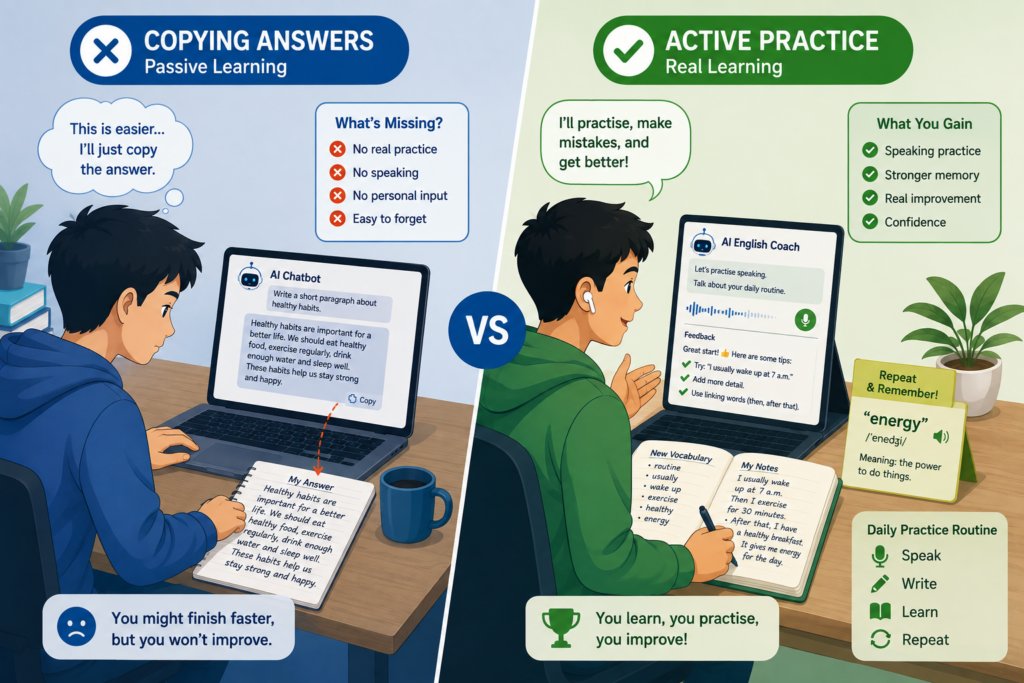
Comparing passive and active ways of using AI to learn English.
What AI Can’t Do for You
AI is powerful, but it can’t speak for you in real life.
It can’t attend your job interview.
It can’t order food at a restaurant.
It can’t build confidence while talking to another person.
Those skills come from practice.
If you rely on AI to write every email or answer every question, you may improve your reading but struggle when it’s time to speak.
That’s why it’s important to balance technology with active learning.
Five Smart Ways to Use AI to Learn English
1. Practise Real Conversations
Ask AI to act as:
- A customer
- A colleague
- A hotel receptionist
- A teacher
- A friend
Respond naturally instead of asking AI to write every answer for you.
Example prompt:
“Pretend you’re a customer at a coffee shop. Ask me questions one at a time and correct my English after each reply.”
This helps you build confidence without feeling overwhelmed.
2. Learn Vocabulary in Context
Don’t ask for a list of 100 words.
Instead, ask:
“Teach me ten useful English words for travelling. Include meanings, example sentences, and a short quiz.”
Learning words in context makes them easier to remember.
3. Improve Your Writing
Write your paragraph first.
Then ask AI:
- Is my grammar correct?
- Which words sound unnatural?
- Can you explain my mistakes?
- How can I make this sound more natural without changing my meaning?
This approach teaches you rather than simply giving you the answer.
4. Build Speaking Confidence
One reason people use AI to learn English is that they can practise without feeling embarrassed.
Try recording yourself speaking for one minute.
Then ask AI to help you improve:
- pronunciation
- vocabulary
- grammar
- sentence variety
The goal isn’t perfection. It’s progress.
5. Create a Personal Study Plan
AI can help organise your learning.
Ask it to create a weekly schedule based on your goals.
For example:
| Day | Activity |
| Monday | Vocabulary practice |
| Tuesday | Speaking exercise |
| Wednesday | Listening practice |
| Thursday | Writing correction |
| Friday | Conversation practice |
| Saturday | Review difficult topics |
| Sunday | Watch an English movie and summarise it |
A structured routine is easier to follow than random lessons.
Three Mistakes to Avoid
Mistake 1: Copying Everything
If AI writes every sentence for you, you’re not learning.
Always try first.
Then ask for feedback.
Mistake 2: Never Speaking
Reading AI responses isn’t the same as speaking.
Read answers aloud.
Repeat new phrases.
Have conversations whenever possible.
Mistake 3: Believing AI Is Always Correct
AI sometimes makes mistakes.
If something seems confusing, compare explanations with a trusted dictionary or grammar resource.
Learning to question information is part of becoming an independent learner.
Try This 15-Minute Daily AI Routine
Want a simple way to improve your English?
Try this.
5 minutes
Ask AI to teach you five new words.
5 minutes
Have a short conversation with AI about your day.
5 minutes
Write a short paragraph and ask AI to explain your mistakes instead of rewriting everything.
That’s only fifteen minutes, but it helps you practise reading, writing, vocabulary, and speaking.
Mini Challenge
Open your favourite AI assistant and complete these three tasks.
☐ Introduce yourself in English.
☐ Describe your favourite hobby.
☐ Ask AI to identify three grammar mistakes and explain why they are mistakes.
Now rewrite your answers without looking at the corrections.
If you can do that, you’re learning instead of copying.
Final Thoughts
Using AI to learn English can make learning faster, more flexible, and more enjoyable.
The key is to use AI as a coach, not a replacement for practice.
Write before asking for corrections.
Speak before asking for improvements.
Think before asking for answers.
When you combine AI with consistent practice, you’ll build skills that stay with you long after you close your laptop.
Frequently Asked Questions
Is AI good for learning English?
Yes. AI can help with grammar, vocabulary, writing, and conversation practice. It works best when you use it as a learning partner instead of relying on it for every answer.
Can AI improve my speaking?
AI can help you practise conversations and receive feedback, but speaking with real people is still one of the best ways to build confidence.
Which AI tools can I use?
Many learners use ChatGPT, voice assistants, grammar checkers, and AI language-learning apps. Choose tools that encourage practice rather than simply providing answers.
Check these out:
- Why You Understand English but Can’t Speak: 7 Proven Ways to Build Speaking Confidence
https://fluent-eng.com/why-you-understand-english-but-cant-speak/ - Stop Sounding Like a Textbook: 35 Everyday English Phrases Native Speakers Actually Use
https://fluent-eng.com/35-everyday-english-phrases-native-speakers-use/
Read Next
Can You Pass This Everyday English Challenge? 20 Situations Most Learners Get Wrong
Put your skills to the test with interactive scenarios based on real-life conversations. See how many everyday situations you can handle confidently and discover where you can improve.