


Have you ever said something in English that was grammatically correct… but people looked at you a little strangely?
Don’t worry.
It happens to almost every English learner.
Many textbooks teach English that is technically correct but rarely used in everyday conversations. Native speakers often choose shorter, simpler, and more natural expressions.
Learning everyday English phrases won’t just help you sound more fluent. They’ll also help you understand movies, podcasts, TV shows, colleagues, and friends much more easily.
Let’s look at some expressions you’ll hear every day.
Why Textbook English Sounds Different
Textbooks are designed to teach grammar and vocabulary.
Real conversations are different.
People shorten sentences.
They use contractions.
They leave out words because the listener already understands the meaning.
For example, instead of saying,
“I am extremely tired.”
A native speaker is more likely to say,
“I’m exhausted.”
or simply,
“I’m worn out.”
Neither is more correct.
One just sounds more natural.
1. Greeting Someone
Instead of:
❌ How do you do?
Try:
✅ Hi!
✅ Hey!
✅ How’s it going?
✅ What’s up?
✅ Morning!
These are everyday English phrases you’ll hear much more often.
2. Saying You’re Busy
Instead of:
❌ I have many tasks today.
Say:
✅ I’ve got a lot on my plate.
✅ I’m swamped.
✅ I’m tied up right now.
Example:
“I’d love to help, but I’m swamped today.”
3. Saying Something Is Easy
Instead of:
❌ It is very easy.
Say:
✅ It’s a piece of cake.
✅ No problem.
✅ That’s easy.
4. Agreeing With Someone
Instead of:
❌ I agree with your opinion.
Say:
✅ Exactly.
✅ Absolutely.
✅ That’s true.
✅ I couldn’t agree more.
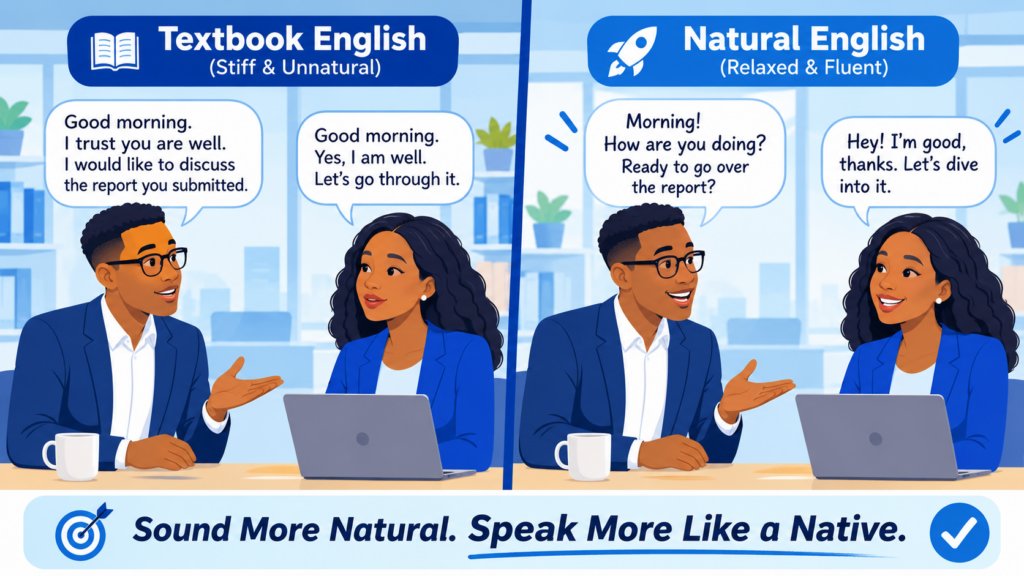
Office colleagues using natural English expressions instead of formal textbook language.
5. Saying You Don’t Know
Instead of:
❌ I do not know.
Try:
✅ I’m not sure.
✅ No idea.
✅ Beats me.
Choose the expression depending on the situation.
6. Ending a Conversation
Instead of:
❌ Goodbye.
You could also say:
- See you later.
- Catch you later.
- Take care.
- Have a good one.
- Talk soon.
7. Reacting to Good News
Native speakers often say:
- That’s awesome!
- Nice!
- That’s great!
- Good for you!
- Congratulations!
Simple words often sound the most natural.
8. Talking About Time
Instead of:
❌ I must leave now.
Say:
- I’ve got to go.
- I’d better get going.
- Time to head out.
These everyday English phrases appear constantly in real conversations.
9. Asking Someone to Repeat
Instead of saying,
“Repeat your statement.”
Try:
- Sorry?
- Could you say that again?
- I didn’t catch that.
- One more time?
Much more natural.
10. Responding When Someone Thanks You
Instead of only saying,
“You’re welcome.”
You can also say:
- No problem.
- Anytime.
- Happy to help.
- My pleasure.
- Of course.
Mini Challenge
Can you replace the formal sentences with natural English?
| Formal | Your Answer |
| I am very tired. | __________ |
| I agree with you. | __________ |
| I do not know. | __________ |
| I must leave now. | __________ |
| It is very easy. | __________ |
Try answering before scrolling back to check the examples.
Why These Expressions Matter
Learning grammar is important.
But communication isn’t only about grammar.
Imagine meeting a new colleague.
Which sounds more natural?
Person A
“I am pleased to make your acquaintance.”
Person B
“Nice to meet you.”
Both are correct.
Only one sounds like everyday conversation.
(Person A sounds extremely formal and old-fashioned)
That’s why learning everyday English phrases can make your English sound smoother and more confident.
How to Remember Everyday English Phrases
Don’t memorise long lists.
Instead:
✔ Learn five phrases each week.
✔ Use each phrase three times.
✔ Write your own examples.
✔ Say them aloud.
✔ Listen for them in TV shows and podcasts.
The more often you notice these phrases, the faster they’ll become part of your own vocabulary.
Final Thoughts
If your English sometimes sounds too formal, don’t worry.
That’s a normal stage of learning.
The more everyday English phrases you hear and practise, the more naturally you’ll speak.
Focus on expressions people actually use.
Soon, you’ll spend less time translating from a textbook and more time having real conversations with confidence.
Frequently Asked Questions
How many everyday English phrases should I learn each week?
Five to ten phrases is a realistic goal. Using them in conversations is more important than memorising long lists.
Are idioms the same as everyday English phrases?
Not always. Some everyday English phrases are idioms, but many are simply common conversational expressions that native speakers use every day.
Can I use these phrases at work?
Most of the phrases in this article are suitable for casual workplace conversations. For formal presentations or business emails, choose more professional language when appropriate.
Suggested for you:
Read Next
How to Use AI to Learn English Without Becoming Dependent on It
Discover how to turn AI into a personal English coach while still building real speaking, listening, reading, and writing skills on your own.