

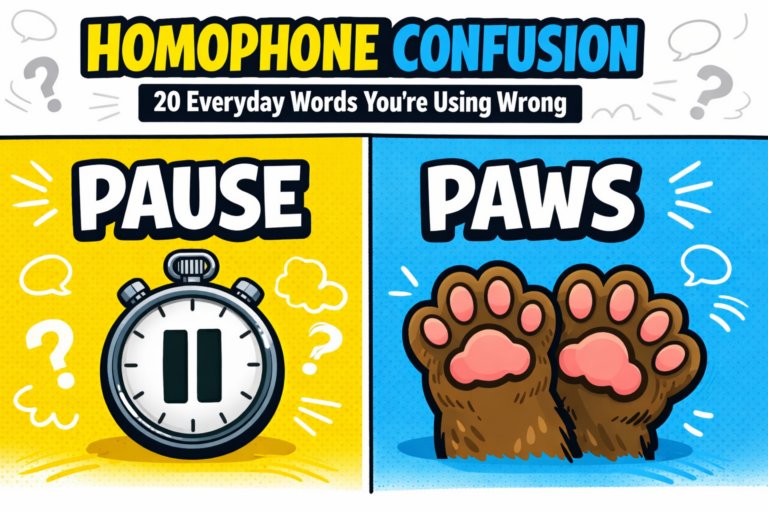
Homophones confuse students more than almost any other English vocabulary topic—and that’s because homophones sound the same but behave very differently in writing.
If you’ve ever written a sentence, paused, and wondered, “Is this the right spelling?”, then homophones are exactly what tripped you up.
Let’s break it down properly.
What Are Homophones?
Homophones are words that have the same pronunciation but different spellings and meanings.
They sound identical when spoken, but they change meaning completely when written, reminding learners that English is not always spelt the way it sounds.
Understanding homophones helps learners write more accurately, speak more confidently, and avoid common mistakes in exams and real-life communication.
Now, let’s look at 20 practical homophones you’ll actually use.
20 Essential Homophones with Clear Meanings
1. Aisle / Isle
Aisle – a narrow passage you walk through, especially between seats in a church, plane, or supermarket.
Isle – a small island, often surrounded by water.
Pronunciation: /aɪl/
2. Bored / Board
Bored – the feeling you have when something is not interesting or engaging.
Board – a flat piece of wood, or a group of people managing an organization.
Pronunciation: /bɔːd/
3. Complement / Compliment
Complement – something that completes, improves, or works well with something else.
Compliment – a polite or positive comment you give to praise someone.
Pronunciation: /ˈkɒmplɪmənt/
4. Forth / Fourth
Forth – moving forward or outward from a place.
Fourth – the position or number that comes after third.
Pronunciation: /fɔːθ/
5. Idle / Idol
Idle – not working, active, or being used at the moment.
Idol – a person who is greatly admired, loved, or followed by others.
Pronunciation: /ˈaɪdl/
6. Lessen / Lesson
Lessen – to make something smaller, weaker, or less serious.
Lesson – a period of teaching or something learned from experience.
Pronunciation: /ˈlesn/
7. Medal / Meddle
Medal – a metal award given for achievement, especially in sports or competitions.
Meddle – to interfere in something that is not your responsibility.
Pronunciation: /ˈmedl/
8. Morning / Mourning
Morning – the early part of the day, from sunrise until noon.
Mourning – the expression of deep sadness, especially after someone dies.
Pronunciation: /ˈmɔːnɪŋ/
9. Naval / Navel
Naval – relating to ships, sailors, or the navy.
Navel – the small mark on the stomach where the umbilical cord was attached.
Pronunciation: /ˈneɪvl/
10. Pause / Paws
Pause – a short break or stop in action or speech.
Paws – the feet of animals such as dogs or cats.
Pronunciation: /pɔːz/
11. Principal / Principle
Principal – the head of a school or the most important person or thing.
Principle – a moral rule, belief, or basic truth that guides behavior.
Pronunciation: /ˈprɪnsəpəl/
12. Profit / Prophet
Profit – money gained after costs are removed in a business or activity.
Prophet – a person believed to deliver messages from God in religious history.
Pronunciation: /ˈprɒfɪt/
13. Stationary / Stationery
Stationary – not moving or staying in one position.
Stationery – paper, pens, envelopes, and other writing materials.
Pronunciation: /ˈsteɪʃənri/
14. Steal / Steel
Steal – to take something that does not belong to you without permission.
Steel – a strong metal commonly used in construction and tools.
Pronunciation: /stiːl/
15. Symbol / Cymbal
Symbol – a sign or object that represents an idea or meaning.
Cymbal – a round metal instrument used in music, especially drums.
Pronunciation: /ˈsɪmbəl/
16. Taught / Taut
Taught – the past tense of teach, meaning someone was instructed or educated.
Taut – stretched tightly and not loose.
Pronunciation: /tɔːt/
17. Vain / Vein
Vain – overly proud of appearance, or something done with no result.
Vein – a blood vessel that carries blood through the body.
Pronunciation: /veɪn/
18. Weather / Whether
Weather – the condition of the atmosphere, such as rain, heat, or wind.
Whether – used to show a choice or doubt between options.
Pronunciation: /ˈweðə/
19. Yoke / Yolk
Yoke – a wooden bar used to join animals together, or to connect things.
Yolk – the yellow part inside an egg.
Pronunciation: /jəʊk/
20. Weak / Week
Weak – lacking strength, power, or energy.
Week – a period of seven days.
Pronunciation: /wiːk/
Why ESL Learners Must Take Homophones Seriously
Homophones are not just spelling tricks—they affect:
- Exam accuracy
- Writing clarity
- Professional communication
- Confidence when using English
The more homophones you master, the fewer mistakes you make, and the more natural your English becomes.
Click below to learn more about confusing English words.
https://fluent-eng.com/12-most-confusing-english-words-right-no-wrong/