

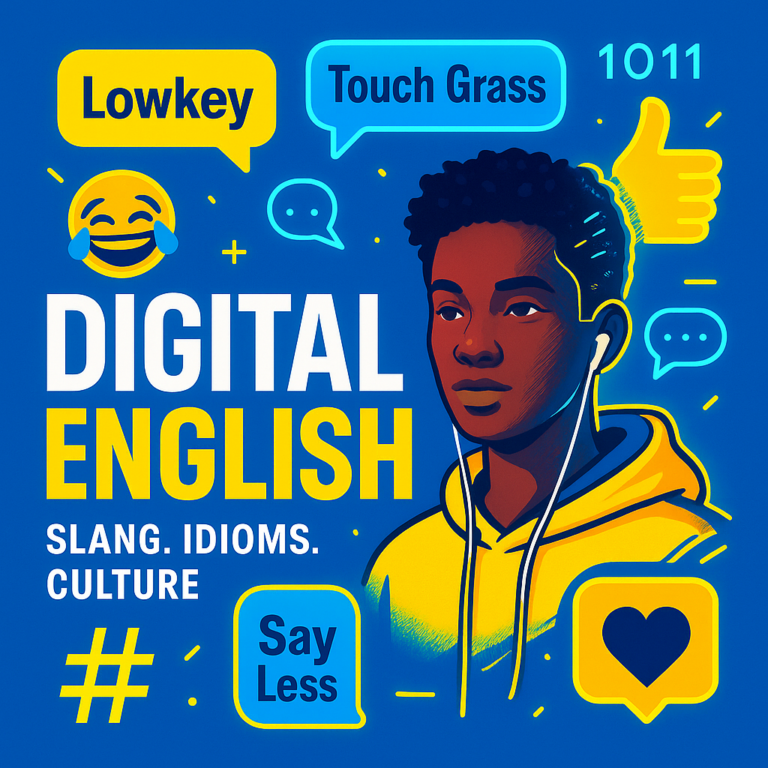
Digital English slips into conversations faster than you can refresh your feed, and sometimes it hits you out of nowhere. One second you’re minding your business, and the next someone says, “I’m screaming,” even though nobody is making a sound. Or they drop a casual “That’s crazy work” after you send a normal email. And you sit there thinking… when did everyone start talking like this?
That moment right there is why this topic matters. The way people speak today is shaped by viral moments, niche communities, memes that live and die in 48 hours, and slang that hops from TikTok to real life as if it pays rent. If you want to communicate smoothly across cultures and online spaces, you need more than vocabulary lists. You need cultural fluency. You need a feel for digital English because that’s the pulse behind how people actually talk.
And honestly, once you understand the rhythm of it, everything becomes more fun. Conversations feel easier. Jokes click faster. You stop feeling like you’re missing the “secret rules” of online language. Let’s get into it.
Why slang hits different now
Slang: informal expressions created within groups that quickly spread and reflect shared attitudes or trends.
Slang used to stay inside neighbourhoods or tight friend circles. Now it spreads like glitter. A phrase drops in Los Angeles, and by the evening, someone in Nairobi is using it in a WhatsApp chat.
That’s the magic of digital English. It turns the internet into one huge melting pot where cultures mix vocabulary nonstop. You see phrases like:
- “I’m lowkey obsessed.”
- “Say less.”
- “She ate and left no crumbs.”
Slang adds flavour to your speech. It makes you sound real instead of stiff. And the moment you understand the emotion behind a phrase, you step into a new level of cultural fluency.
Idioms aren’t old-school anymore
Idiom: a fixed expression whose meaning can’t be understood from the literal words.
People assume idioms belong in dusty grammar books, but modern culture creates new idioms every week. And they stick. Hard.
Think about:
- “Touch grass.”
- “That aged like milk.”
- “Main character energy.”
These behave just like traditional idioms but are fully part of internet culture. Once you learn them, you start to understand sarcasm, jokes, and references that fly across timelines at ridiculous speed.
Idioms give you access to tone and context. And in digital English, tone is everything.
Social media rewired the way we talk
Digital English / Social-Media Language: the informal, fast-evolving style of communication shaped by online platforms, trends, memes, emojis and internet culture.
Open any app, and you’ll notice something immediately. People aren’t just talking. They’re performing small stories with sentence breaks, emojis and dramatic pauses.
- all lowercase for a softer tone
- “…” to show a pause or a side thought
- stretched words liiiike this for emotion
- The skull emoji means “I’m laughing too hard”
This is digital English at work. It’s expressive. It’s emotional. It’s chaotic sometimes. But once you understand the rhythm, online spaces start feeling comfortable instead of overwhelming.
You learn the difference between “I’m fine” and “im fine…”
Between “LOL” and “💀”.
Suddenly, the whole internet becomes readable.
Cultural fluency is the real superpower
Cultural fluency helps you read the room even when the room isn’t physical. It’s the ability to understand tone, subtext and intention.
Two people can say, “You did that”
One is celebrating you.
The other is joking.
Only context reveals it.
If your goal is smooth communication, especially with people from different backgrounds, digital English becomes one of your strongest tools. Every online community has its own rhythm. Gaming spaces. Fashion spaces. Black Twitter. K-pop fandoms. Comedy creators. When you understand their tone, conversations stop feeling like code.
You connect faster. You avoid misunderstandings. You sound like someone who actually belongs.
So, how do you get better at Digital English?
You don’t study it. You absorb it. Like sunlight.
Here’s how:
1. Watch creators from different parts of the world
Each one carries a unique English flavour. You learn tone, pacing and cultural nuance without even trying.
2. Study comment sections
Comments move quicker than posts. New phrases pop up daily.
3. Participate instead of lurking
A single reply teaches you more than a chapter in a textbook.
4. Try the language in your captions or messages
Play around. Make mistakes. It’s part of the fun.
5. Follow trend trackers
They keep you updated on what’s new in digital English, so you don’t feel lost when a phrase suddenly goes global.
Soon, you’ll notice you’ve developed a natural instinct for tone and timing. That’s fluency.
Digital English is a cultural bridge
The internet blends accents, cultures, humour styles and storytelling traditions. Someone in Brazil and someone in Ghana can laugh at the same meme. Someone in the Philippines can use a phrase that someone in London immediately understands.
Digital English acts like a global handshake.
You feel connected.
You feel included.
You speak a language shaped by everyone.
It doesn’t erase culture. It amplifies it. And somehow, it still pulls people together.
Final thoughts
Language has always grown, but this era hits different. The culture shifts fast. The memes move fast. And communication reflects all of it. When you learn digital English, you don’t just learn vocabulary. You learn people. You learn rhythm. You learn connection.
It’s not about sounding trendy. It’s about sounding alive.
Curious. Present.
Part of the shared world we all speak into every day.
Keep exploring. Keep absorbing. And let digital English find its way into your voice in a way that feels natural to you.
Click below to learn more about English slang and boost your English fluency.
https://fluent-eng.com/english-texting-slang-use-emojis-like-the-natives/