

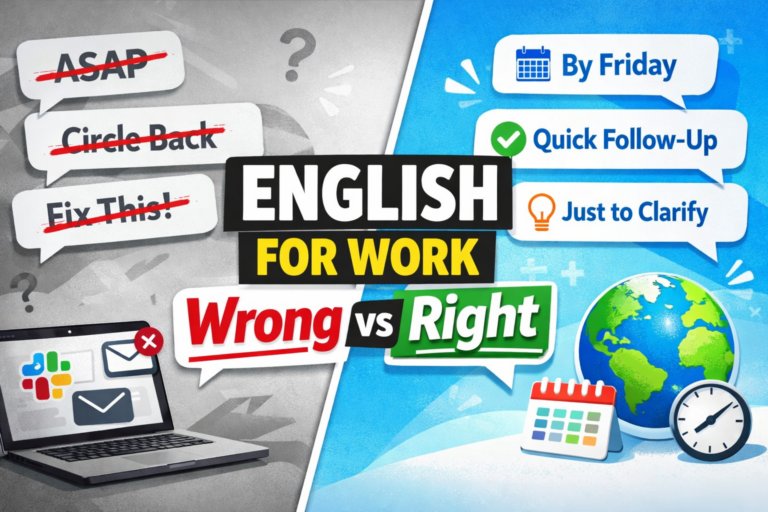
English for work quietly decides how far your remote career goes before anyone looks at your CV.
In global workplaces, your skills get you hired. Your communication determines whether people trust you, rely on you, and invite you into more significant conversations. Remote work strips away body language and tone. What’s left are your words on a screen. That’s why English for work isn’t about sounding smart. It’s about sounding clear, human, and easy to collaborate with.
Below is the version of workplace English that is actually used on the job. Short explanations. Lots of real examples. Wrong vs right, side by side, the way you’ll see them in Slack, email, and meetings.
The real goal of workplace English
The goal of English for work is simple. Reduce friction.
Friction looks like confusion, awkward silence, endless follow-ups, or messages that get ignored because no one knows what to do next.
Good workplace English answers three things quickly:
• What’s happening
• What’s needed
• By when
Everything else is decoration.
Core workplace vocabulary. Wrong vs right use
1. “ASAP”
Wrong
“Please fix this ASAP.”
It sounds urgent. It also sounds stressful and unclear.
Right
“Please fix this by 3 PM today if possible.”
English for work prefers clarity over pressure.
2. “Circle back”
Wrong
“Let’s circle back later.”
No timeline. No ownership. Nothing moves.
Right
“Let’s revisit this on Thursday after the client call.”
Global teams need dates, not vague promises.
3. “Feedback”
Wrong
“I didn’t like this.”
Too blunt. Feels personal.
Right
“One piece of feedback. The intro could be clearer for first-time users.”
This is English for work that keeps relationships intact.
4. “Alignment”
Wrong
“We’re not aligned.”
That sounds like blame.
Right
“I think we might be interpreting the goal differently. Here’s how I understand it.”
Same issue. Better delivery.
5. “Following up”
Wrong
“Why haven’t you replied?”
Defensive. Accusatory.
Right
“Just following up in case my last message got buried.”
Polite. Professional. Normal in remote teams.
Email English that doesn’t sound stiff or careless
Emails are where English for work gets tested daily.
Subject lines
Wrong
“Question”
No one knows what this is about.
Right
“Question about Q3 report deadline”
People open what they understand.
Requests
Wrong
“I need this today.”
Sounds demanding.
Right
“Could you share this today so I can finalise the report?”
Same request. Better tone.
Updates
Wrong
“I’m still working on it.”
That invites follow-up questions.
Right
“I’m working on it and will send an update by EOD.”
Clear expectation. Less stress.
Slack and chat messages. Short but complete
Remote work runs on chat. English for work here needs to be brief but precise.
Asking for help
Wrong
“I’m stuck.”
On what? Where? Why?
Right
“I’m stuck on the API integration step. Do you know who owns that?”
Now someone can help.
Assigning tasks
Wrong
“Can someone handle this?”
No owner. No urgency.
Right
“Can you take this, Alex? It’s needed by tomorrow morning.”
Clear ownership changes everything.
Sharing bad news
Wrong
“This didn’t work.”
That creates panic.
Right
“This approach didn’t work, so I’m testing an alternative now.”
Problem plus action. That’s English for work maturity.
Meeting language that keeps you confident
You don’t need to speak a lot in meetings. You need to speak clearly when you do.
Joining the conversation
Wrong
“I don’t understand.”
That can feel abrupt.
Right
“Can I clarify one point before we move on?”
Soft entry. Same outcome.
Disagreeing politely
Wrong
“That’s wrong.”
Too direct for many cultures.
Right
“I see it slightly differently based on the data.”
Professional disagreement travels well globally.
Buying time
Wrong
Silence.
People assume you’re disengaged.
Right
“Let me think through that for a second.”
Small phrases build presence.
Project language that avoids confusion
Projects fail more from communication than effort. English for work helps here a lot.
Deadlines
Wrong
“We should finish soon.”
Soon means nothing.
Right
“The draft will be ready by Friday, final version by Monday.”
Now everyone relaxes.
Scope
Wrong
“This includes everything, right?”
Dangerous assumption.
Right
“Just to confirm, this covers design only, not development.”
Assumptions are expensive.
Blockers
Wrong
“I can’t continue.”
That sounds final.
Right
“I’m blocked until I get access to the dashboard.”
Now the problem has a solution.
Cultural awareness through language
Global teams interpret words differently. English for work helps you soften edges.
Direct vs indirect
Wrong
“Fix this.”
In some cultures, that feels harsh.
Right
“Could we adjust this section slightly?”
Same meaning. Better reception.
Praise matters
Wrong
Silence after good work.
Some cultures see silence as disapproval.
Right
“This looks great. Thanks for turning it around quickly.”
Small praise builds trust across borders.
Common phrases remote teams expect
You’ll see these everywhere. Learn them. Use them naturally.
• “Just to clarify…”
• “For visibility…”
• “Happy to help.”
• “Let me know if that works.”
• “Does that timeline work for you?”
This is everyday English for work, not fancy business talk.
How to practice without studying harder
You don’t need grammar drills. You need exposure.
Try this:
• Save good messages from teammates
• Rewrite your own messages once before sending
• Notice how managers phrase requests
• Pay attention to follow-up language
You’ll absorb English for work faster by copying real patterns than by memorizing rules.
Career growth and communication
Remote promotions often go to people who are easy to work with. That usually means clear communicators.
Strong English for work shows up as:
• Clear updates
• Calm problem solving
• Respectful disagreement
• Reliable follow-through
People trust what they understand.
Final takeaway
English for work isn’t about being perfect. It’s about being understood the first time. Compact messages. Clear intent. Human tone. In remote and global workplaces, that skill quietly separates those who get overlooked from those who move forward.
Click below to discover more important English Phrases for the workplace.
https://fluent-eng.com/mastering-persuasive-english-for-sales-success/